

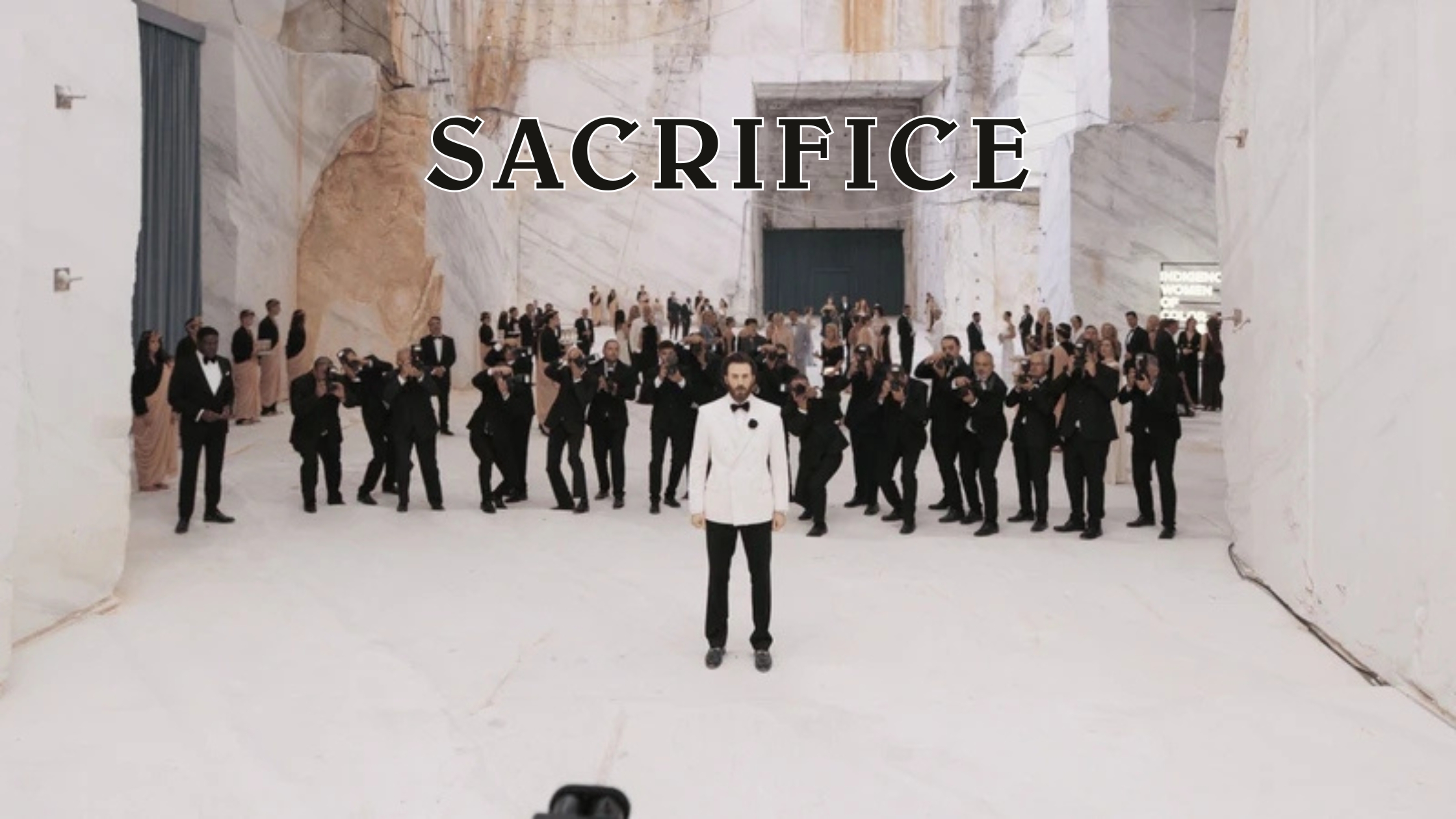
Sacrifice — a loud, strange eco-satire that wants to be a fever dream.
Romain Gavras’s Sacrifice is the kind of festival film that announces itself with style, star power, and an agenda: it’s messy, loud, often provocative, and built around a single showpiece premise — what happens when a radical group interrupts a glitzy gala and insists some kind of ritual cleansing will save the planet. The movie premiered in the Special Presentations section at the 2025 Toronto International Film Festival and immediately divided critics: some admired its audacity; others found its satire shallow. Either way, it’s the sort of film that makes people talk.
Short synopsis (the setup you need to know).
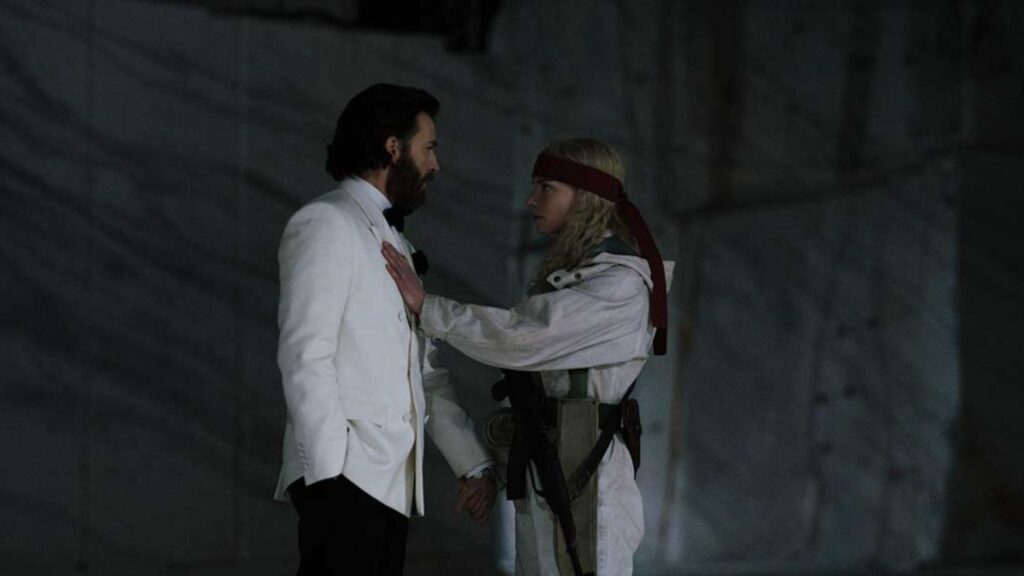
At a high-end charity gala full of celebrities, billionaires and virtue-signaling donors, a radical militant named Joan (Anya Taylor-Joy) storms the event with followers who believe in an apocalyptic volcanic prophecy. They take three people hostage — a movie star in the middle of a career crisis, a cold billionaire, and an unlucky performer — claiming that by “sacrificing” them they’ll save humanity. As the night turns catastrophic, the film alternates between violent spectacle, personal reckonings, and a satirical look at celebrity, activism, and performative morality. That premise — part hostage thriller, part eco-satire, part fever dream — is the movie’s motor.
Who’s in it — cast size and principal players.
If you want a simple headcount: the film is top-heavy with marquee names, but it’s not an ensemble of hundreds. The principal credited cast (the people who drive the narrative) includes:
- Anya Taylor-Joy as Joan (the zealot/abductor).
- Chris Evans as Mike Tyler (a movie star and one of the hostages).
- Salma Hayek as Gloria Bracken (pop star, wife of Ben).
- Vincent Cassel as Ben Bracken (the billionaire).
- Ambika Mod as Katie (the unlucky performer / third hostage).
- Sam Richardson as Oliver (Mike’s agent).
- John Malkovich as Gunnar (Joan’s father).
- Charli XCX and Yung Lean in notable supporting or cameo roles, plus a handful of other credited players (Jade Croot, Jeremy O. Harris, Miriam Silverman and others).
Count every bit player and background extra and the credits grow into the dozens — but narratively, the film centers on roughly a dozen named actors, with Taylor-Joy, Evans, Cassel and Hayek occupying the key dramatic positions. If you’re asking how many cast in this movie in the practical sense (who you should recognize): expect a tight list of major names and a supporting crowd that fills the gala and the cult cells.
Who is the “main” (means) character? — where the movie’s heart tries to sit.
Tonally, Sacrifice is not a tidy character study — it’s a collage. Still, if you must pick a “means character” (the person through whose experience the story most often gets filtered), the film gives us Mike Tyler (Chris Evans) as the clearest emotional touchstone: a movie star in the middle of a crisis who’s forced into an existential, very public humiliation. That said, Joan (Anya Taylor-Joy) — the militant catalyst — is never simply a plot device; she’s the ideological engine and occupies the screen with an unnerving intensity. In practice the film alternates between Joan’s religious-ecological fervor and Mike’s bewildered, performative humanity — so the “main” seat is shared.
Box office / “box collection” — what it made (so far).
As of its TIFF premiere and initial festival coverage, Sacrifice was still in the festival / pre-release window, and no wide commercial box-office totals have been publicly reported. Box-office trackers list the title (and will publish grosses once the film opens in commercial wide release), but at festival time the public financial picture is not yet available. In short: distribution buzz exists, but concrete box-office figures (domestic, international, or worldwide gross) were not published at the time of the festival coverage. If you want precise dollar totals, Box Office Mojo and The Numbers will be the go-to sources once the theatrical window begins.
The niche — who this film was made for (and who it will find).
Sacrifice sits in a particular corner of contemporary festival cinema:
- It’s a political / eco-satire with a thriller surface: people who like provocative social commentary wrapped in genre trappings are the primary audience.
- It’s aimed at festival cinephiles and critics who enjoy bold directorial thumbprints — Romain Gavras arrives with a reputation for visually aggressive, music-video aesthetics.
- It will also attract viewers drawn to star vehicles (Taylor-Joy, Evans, Hayek, Malkovich) and viewers curious about films that interrogate celebrity, wealth, and performative virtue.
- It is not a family-friendly blockbuster: this is loud, jagged, and designed to be discussed (or derided) afterward.
If you like satirical, slightly allegorical films about power and spectacle — think of it as sitting beside films that lampoon celebrity excess while leaning hard into stylistic provocation.
Deep dive — what the film does (and what it doesn’t).
Romain Gavras’s tone and approach
Gavras — whose background includes kinetic music videos and incendiary visuals — brings a hand that prefers rupture and shock to slow burn. Sacrifice opens with a violent ritual and then flips rapidly into a hostage-situation thriller that’s half media critique, half morality play. The director’s impulse is to overwhelm the senses: frantic camera moves, staged chaos, and interstitial moments of surreal ritual. That makes the film feel urgent and combustible — and, to some critics, undernarrated.
Satire and targets
The Sacrifice film wants to skewer three interlocking targets:
- Celebrity culture — fame as a performance that obscures emptiness; Mike Tyler’s public image versus private vulnerability is a long-running gag and ache.
- Billionaire privilege — Ben Bracken (Vincent Cassel) stands for global wealth insulated from consequence, a perfect foil for the militants’ fury.
- Performative activism / virtue signaling — the gala guests habitually posture as saviors while simultaneously perpetuating systemic harm. The movie stages their moral bankruptcy with relish.
Where the satire works is in specific images — how a red-carpet speech sounds in the mouth of an irrelevant celebrity, or the disorienting intimacy of a violent ritual filmed as pageantry. Where it falters, critics say, is in failing to do anything substantially new with those ironies: the Sacrifice film points at hypocrisy but sometimes seems content to merely amplify it.
Performances — who lands and who lurches
- Anya Taylor-Joy is committed and magnetic as Joan: she’s frightening without being cartoonish, and she gives the cult’s convictions a brittle, personal weight.
- Chris Evans turns in a more ambiguous performance; he plays vulnerability with a performative edge that suits the film’s theme (the actor as public commodity).
- Vincent Cassel and Salma Hayek provide the necessary sheen of old-world menace and showroom glamour. Sam Richardson offers comic relief as a flummoxed agent who represents the PR machinery that keeps celebrities afloat.
Critics are mixed on whether the actors rescue the material: many praise the central cast for commitment, but some reviews conclude that stellar performances can’t fully paper over a script that, to their minds, doesn’t always cohere.
The film’s structural risks
Sacrifice is hybrid: part allegory, part hostage drama, part social commentary. That hybridity is energetic but risky: the Sacrifice film sometimes feels tonally whiplashed — shifting quickly from pitch-black humor to violence to sincere emotional beats that don’t quite land. For viewers who prize cohesion and argument, this can be frustrating; for viewers who enjoy provocation above all, it’s precisely the point.
What critics said (in sum)
Festival reviewers ran the gamut: Variety called it a work that opens violently and then unevenly pivots into satire; ScreenDaily praised Gavras’s visual verve but flagged narrative muddle; some outlets found unexpected emotional impact beneath the noise. Rotten Tomatoes and festival write-ups reflect a polarized reaction: many admired the audacity, a notable minority found it shallow. (Festival premieres tend to produce this sort of scatter.)
Who should watch Sacrifice — final verdict.
If you love being provoked — if you like films that feel alive because they risk being wrong — Sacrifice is for you. It’s a movie that trades in spectacle, satire, and performance, and it will reward viewers who enjoy visual bravura and moral shouting matches. If you want tidy answers, character arcs that resolve neatly, or satire with surgical precision, this probably won’t satisfy.
It’s loud, occasionally brilliant, and often maddening — the kind of Sacrifice film that will be argued about over the next festival season. And in 2025’s crowded festival landscape, that argument is a kind of success.