


Nouvelle Vague — A Love Letter to the New Wave.
Nouvelle Vague is Richard Linklater’s 2025 black-and-white, French-language ode to the birth of the French New Wave. More precisely, it dramatizes the making of Jean-Luc Godard’s 1960 film Breathless (“À bout de souffle”) — a movie that changed cinema forever. Linklater, known for films like Before Sunrise, Boyhood, and Dazed & Confused, brings his warm, conversational style to this historical piece, blending reverence, nostalgia, and a cinephile’s delight in detail.
Cast — How Many and Who’s In It.
Principal / Key Cast:
- Guillaume Marbeck as Jean-Luc Godard.
- Zoey Deutch as Jean Seberg.
- Aubry Dullin as Jean-Paul Belmondo.
- Bruno Dreyfürst as Georges de Beauregard, the producer backing Godard.
- Benjamin Cléry as Pierre Rissient.
- Matthieu Penchinat as Raoul Coutard, the cinematographer.
- Adrien Rouyard as François Truffaut.
- Antoine Besson as Claude Chabrol.
- Jodie Ruth-Forest as Suzanne Schiffman.
- Pauline Belle as Suzon Faye.
- Blaise Pettebone as Marc Pierret.
- Roxane Rivière as Agnès Varda.
- Côme Thieulin as Éric Rohmer, Laurent Mothe as Roberto Rossellini, Jonas Marmy as Jacques Rivette, among others.
So, in total, the film leans on a fairly large ensemble cast, but the core narrative centers on Godard, Seberg, Belmondo, and their immediate collaborators and peers.
Who’s the “Means” (Main) Character?
The central character — or “means” character — of Nouvelle Vague is Jean-Luc Godard, as portrayed by Guillaume Marbeck. The film follows his journey from critic to filmmaker, his ambition to make Breathless, and his relationships with producers, actors, and fellow New Wave pioneers. Because Linklater’s screenplay pays such close attention to the creative process, Godard’s role is the emotional and narrative fulcrum.
At the same time, Jean Seberg (Zoey Deutch) is very important: she’s not just a romantic interest but an icon of that time, and her presence in the production of Breathless is historically essential. Jean-Paul Belmondo (Aubry Dullin) also plays a significant role, but Godard remains the heart: his vision, self-doubt, and drive shape the film.
Box Office (“Box Collection”).
Here’s what is publicly known about the film’s financial performance so far:
- According to Box Office Mojo, Nouvelle Vague has grossed US$ 996,363 worldwide.
- In France, during its theatrical run, it made about US$ 862,055.
- Netflix acquired U.S. rights after its Cannes premiere — and that streaming deal (rather than a broad U.S. theatrical release) suggests the film’s commercial model leans heavily on digital distribution.
So commercially, Nouvelle Vague is modest — not a blockbuster — which aligns with its identity as an art-house, cinephile-oriented film.
The Niche — Who This Film Is For.
Nouvelle Vague occupies a very particular niche, appealing to:
- Cinephiles and Film Historians
- Those who love or study the French New Wave (Godard, Belmondo, Seberg, Truffaut, Chabrol, etc.) will appreciate how carefully the film recreates the era.
- Independent / Art-House Audiences
- Linklater’s style is conversational, thoughtful, and nostalgic — not high on spectacle but rich in character, history, and reverence.
- Aspiring Filmmakers / Dreamers
- Time’s review described it as a “rallying cry for artistic passion” — a film for young people Linklater says will leave thinking: “I can do this too.”
- Netflix Viewers
- With a streaming release, it’s also perfect for those who discover films via Netflix — especially foreign-language, historical, or indie films.
- Fans of Biographical / Meta Cinema
- The movie is “cinema about cinema.” It’s not purely biopic: it’s a tribute, a reconstruction, and a stylized recreation of a foundational moment in film history.
Deep Dive: Story, Themes, Style, and Execution
Story & Plot
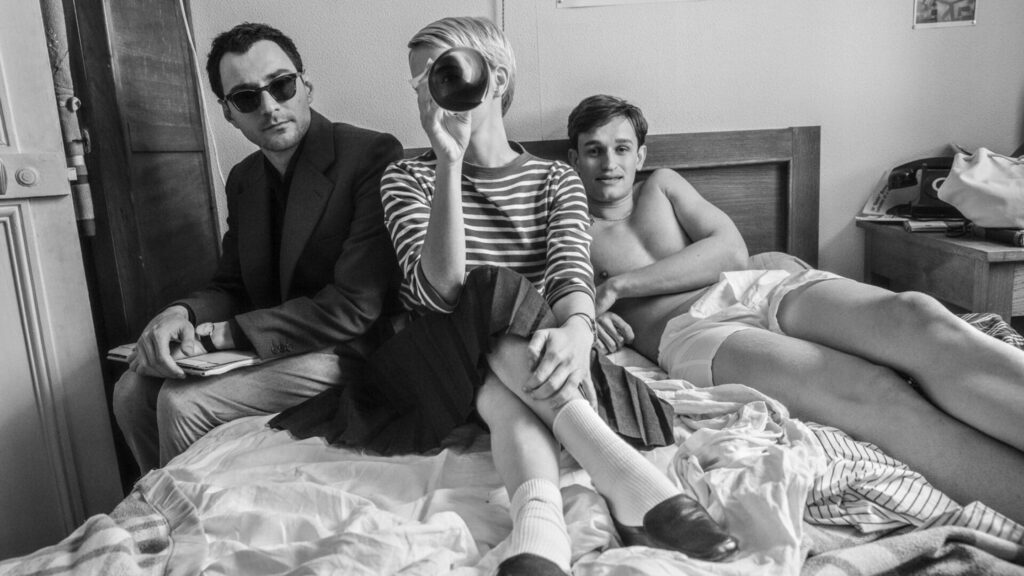
Nouvelle Vague is set primarily in 1959 Paris, as a young Jean-Luc Godard (Guillaume Marbeck) — then critic for Cahiers du cinéma — convinces producer Georges de Beauregard (Bruno Dreyfürst) to fund his first feature film. Godard’s vision, co-written with François Truffaut (Adrien Rouyard), is raw and personal — a story about a couple, crime, and youth.
The film recreates iconic moments from the production of Breathless: casting Jean Seberg (Zoey Deutch), working with the cinematographer Raoul Coutard (Matthieu Penchinat), navigating financial and artistic risks, and collaborating (or quarrelling) with his peers like Truffaut, Chabrol, Rohmer, Varda, René Cocteau, and others.
Linklater plays with structure and tone. Though it’s historical, the narrative is light, witty, and infused with reverence: it doesn’t feel like a dry documentary — more like a daydream about the birth of something revolutionary.
Themes
- Artistic Rebellion
- The French New Wave was all about breaking rules — formally, narratively, technically. Nouvelle Vague celebrates that spirit, showing Godard’s boldness in challenging the status quo.
- Youth & Passion
- The film is suffused with youthful idealism — Linklater captures what it’s like to believe you’re part of something big, even if no one yet fully understands how big.
- Cinema as Life
- For Godard and his circle, cinema is more than a job — it’s a way of seeing, being, and rebelling. The movie highlights that blurry line between art and living.
- Collaboration and Conflict
- Creating Breathless wasn’t easy: relationships, ego, money. Linklater doesn’t shy away from the tension that underlies creative collaboration.
- Legacy and Influence
- The New Wave changed cinema forever. The film imagines how difficult it was in real time, and why its legacy still matters.
Style, Direction & Cinematography
- Linklater shot the movie in black and white with a 4:3 aspect ratio, evoking the look of late-1950s cinema.
- The cinematographer David Chambille brings a timeless, crisp visual style — the framing, lighting, and compositions often feel like a film school tribute to Godard’s own techniques.
- The pacing is thoughtful: the movie doesn’t rush through history but dwells in conversations, production meetings, walks in Paris, and moments of creative uncertainty.
- There’s a warm nostalgia, but Linklater avoids mythologizing: Nouvelle Vague feels affectionate but grounded. Roger Ebert’s review praises how it “transports viewers to a black-and-white vision of the creative milieu of 1959 Paris.”
- Dialogue leans into both French and English (depending on characters and context), underscoring the international nature of the New Wave moment.
Reception & Critical Response
- On Rotten Tomatoes, the film has a 90% “Tomatometer” with a large number of critic reviews.
- The critics’ consensus: “Seamlessly recreating one of cinema’s most groundbreaking productions, Nouvelle Vague doesn’t reinvent the medium … but it pays tribute … with infectious admiration.”
- Richard Linklater’s ambition is frequently praised: many critics say the Nouvelle Vague film is less about spectacle and more about the joy of making movies.
- Some criticism: not all viewers feel deeply involved in the drama — as one review notes, the storytelling can feel “dramatically inert” to those less invested in film history.
- Time’s take: the film is a “compelling and affectionate tribute” but with an eye on “young dreamers … a rallying cry for artistic passion.”
Strengths & Weaknesses
Strengths:
- Historically Rich & Well-Researched — Linklater and his writers clearly did their homework, bringing to life a pivotal moment in film history with respect and detail.
- Authentic Feel — The black-and-white 4:3 shoot and period costumes + dialogue evoke the era without feeling like a museum piece.
- Cast Chemistry — Marbeck (Godard), Deutch (Seberg), Dullin (Belmondo) bring charisma, energy, and a believable passion for their roles.
- Nostalgic & Inspirational — It’s not just for cinephiles; Linklater’s message about creation, risk-taking, and vision feels universal.
- Balanced Tone — It pays tribute without sacralizing its subjects; the film has warmth and humor, not just reverent seriousness.
Weaknesses / Risks:
- Niche Appeal — Viewers unfamiliar with Breathless or the French New Wave may miss many of the historical and cinematic references.
- Dramatic Inertia — For some, the narrative’s pace and focus on behind-the-scenes recreation may feel flat or talky.
- Box-Office Limitations — As an art-house, somewhat niche period piece, it may struggle to appeal to wide mainstream audiences.
- Over-Romanticization — Some critical voices suggest the film idealizes the New Wave era, portraying it through a sentimental lens rather than critically examining its contradictions.
Why Nouvelle Vague Matters
- A Tribute to Film History
- Linklater’s film introduces Breathless and its context to a new generation, celebrating the audacity and youthful spirit that shaped modern cinema.
- A Love Letter to Creativity
- It’s about how passionate, rebellious artists collaborate — and how creation is messy, risky, and filled with doubt.
- Global / Cross-Cultural Filmmaking
- An American director (Linklater) making a French-language, historically French film; it’s a bridge between cine-cultures.
- Inspiration for Young Artists
- As Linklater himself put it, the movie is for young people: a reminder that even legendary auteurs started out as hungry dreamers.
- A Cinematic Conversation
- Nouvelle Vague isn’t just a movie — it’s part of an ongoing conversation about film as art, history, rebellion, and expression.
Final Thoughts.
Nouvelle Vague is not just a film about making a film — it’s a heartfelt, well-crafted celebration of cinema itself. Through its recreation of the early days of Breathless, Linklater invites us into a world of experimentation, youthful defiance, and creative risk-taking. It’s both historical and deeply personal: a tribute not just to a movement, but to the act of filmmaking.
If you love movies, history, or the romance of artistic passion, this is a film to watch. It’s for the cinephile who cherishes Breathless, for the young dreamer who’s ever thought, “I could make a movie,” and for anyone who believes in the power of cinema to change the way we see the world.