

Blue Moon — A Poignant, Intimate Portrait of a Forgotten Lyricist.
Richard Linklater’s Blue Moon (2025) is one of the year’s most talked-about character-driven films — a biographical comedy-drama that strips away spectacle and instead offers an evocative, deeply human portrayal of artistic ambition, heartbreak, and mortality. Built around a single, pivotal night in the life of legendary songwriter Lorenz Hart, the movie unfolds almost like a stage play, succeeding on the strength of performance, dialogue, and emotional nuance rather than big cinematic set pieces.
The film premiered in competition at the 75th Berlin International Film Festival on February 18, 2025 — where Andrew Scott won the Silver Bear for Best Supporting Performance — and later opened theatrically in the United States in October 2025 through Sony Pictures Classics
How Many Cast — Who’s in the Movie.
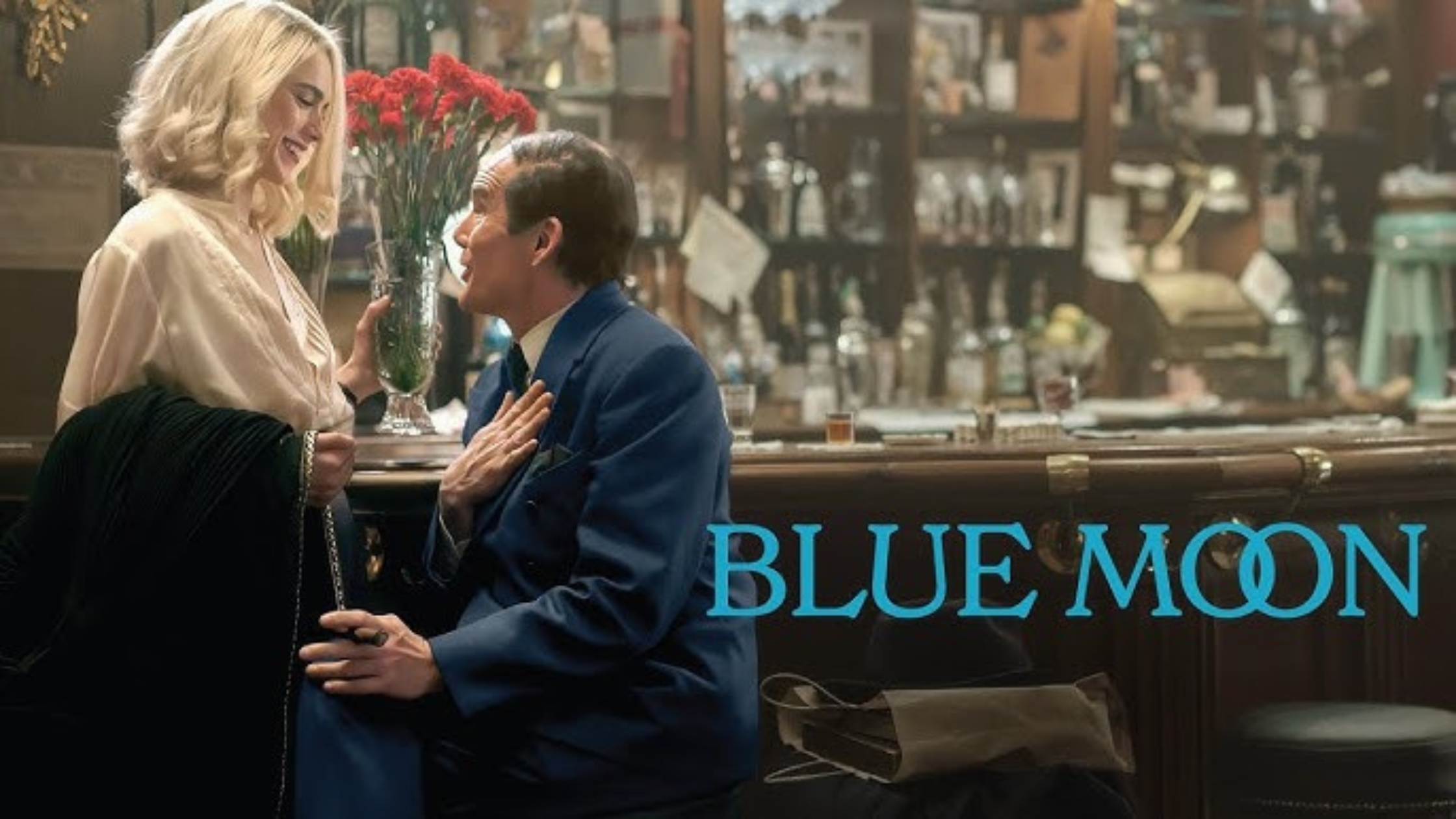
Blue Moon features a focused ensemble rather than a sprawling cast. Because much of the story takes place in a single setting — the historic Sardi’s bar in New York — the narrative privileges character interaction and performance over plot complexity.
Principal Cast
- Ethan Hawke as Lorenz Hart — the brilliant but troubled lyricist at the heart of the film.
- Margaret Qualley as Elizabeth Weiland — a young woman whose connection to Hart offers emotional resonance.
- Andrew Scott as Richard Rodgers — Hart’s former collaborator, whose new success casts Hart’s own struggles into sharp relief.
- Bobby Cannavale as Eddie — a supportive friend and bartender who shares the evening with Hart.
- Simon Delaney as Oscar Hammerstein II — appearing in the story’s broader musical context.
- Patrick Kennedy, Jonah Lees and others fill smaller but significant roles that round out this group.
Though the cast list isn’t long, each member serves a clear dramatic purpose in illuminating Hart’s world — internal and external — on this singular night.
Who Is the “Means” (Main) Character?
The emotional and narrative anchor of Blue Moon is emphatically Lorenz Hart (portrayed by Ethan Hawke). Hart was the lyricist half of the iconic songwriting team Rodgers and Hart, known for classics like Blue Moon and My Funny Valentine. The film follows him on the night of March 31, 1943, the opening of Oklahoma! — a groundbreaking musical not written with him — marking both a professional and personal low point.
While Rodgers (Andrew Scott) and other characters are essential, the story is fundamentally Hart’s night: his reflections on success and failure, his volatile wit, his alcoholic descent, and his longing for connection — romantic and artistic. This is very much a character study, and Hart’s internal landscape drives every scene, verbal exchange, and emotional turn.
Box Office (“Box Collection”) — What It Made.
Blue Moon did not pursue blockbuster box office success — its home is decidedly in the festival and art-house world.
According to box office tracking:
- The film’s domestic gross (United States and Canada) sits around $2,094,975.
- Its international gross accounts for roughly $617,721.
- Combined, Blue Moon has earned about $2.7 million worldwide in theatrical release.
These figures are modest by mainstream standards but typical for a dialogue-driven, adult-oriented historical drama distributed by Sony Pictures Classics. Blue Moon was more focused on critical acclaim and awards season positioning than box-office domination — earning Golden Globe nominations for Best Motion Picture (Musical or Comedy) and Best Actor for Hawke, along with Academy Award nominations for Best Original Screenplay and Best Actor (Hawke).
The Niche — Who This Film Is For.
This movie isn’t for audiences expecting a conventional musical biopic or Broadway spectacle. Its niche sits at the intersection of several audience types:
Character Studies
Blue Moon is essentially a one-night character piece, much like a stage play adapted to film. Audiences who appreciate deep psychological portraits over plot twists will find it richly rewarding.
Music & Theater Lovers
While it’s not a musical in the traditional sense, the film deeply engages with the Golden Age of Broadway, capturing the emotional stakes behind timeless songs and the personal cost of creative partnerships.
Fans of Richard Linklater
Linklater’s longtime collaborators — Ethan Hawke and others — bring a naturalistic, dialogue-rich style that rewards patience and nuance. Those who enjoyed Linklater’s Before trilogy or Me and Orson Welles will feel at home.
Art-House & Festival Crowds
The film’s limited release, awards buzz, and talk-heavy structure place it in the realm of festival cinema and serious drama, rather than mass commercial fare.
In short, Blue Moon is for viewers who like conversation-driven films where the stakes are emotional and intellectual rather than action-packed.
Deep Dive: Story, Themes, Style, and Impact.
Plot Overview (Without Major Spoilers)
Blue Moon unfolds over a single night in 1943 New York City, primarily in and around Sardi’s Bar — a legendary theatrical haunt. Hart (Ethan Hawke) arrives alone on the night that Richard Rodgers’ musical Oklahoma! is premiering — the first show Rodgers created with Oscar Hammerstein II after splitting from Hart.
Hart, once acclaimed for his lyrical partnership with Rodgers, now finds himself in jealousy, alcoholic desperation, and emotional displacement. He drinks, reminisces, jokes, insults, and fluctuates between self-pity and wry humor, flirting with Elizabeth (Margaret Qualley) — a young woman who represents both romantic possibility and generational contrast.
As Hart talks to friends, strangers, and Rodgers himself (Andrew Scott), Blue Moon becomes less a narrative with rising action and more a collision of personality, regret, and artistic identity — Hart’s struggle to find meaning on a night of professional irrelevance.
Key Themes — What the Film Explores.
Creative Obsolescence & Artistic Identity
The heart of the film is Hart’s crisis — he sees his former partner succeed without him, making Broadway history while Hart feels left behind. His talent, once celebrated, feels suddenly irrelevant, and his struggle becomes a meditation on what happens when creators outlive their time (or feel they do).
Alcoholism & Emotional Turmoil
Hart’s reliance on alcohol isn’t portrayed as melodrama but as an emotional crutch and a metaphor for his inability to cope with loss, aging, and unrequited love. The night’s flowing drinks mirror a mind unraveling under pressure.
Love, Yearning, and Creative Loneliness
His platonic infatuation with Elizabeth (Qualley) highlights his yearning for connection beyond professional identity. It also underscores generational divides — Elizabeth represents promise and the future, Hart embodies a past that lingers.
Talk, Wit, and Performance
This is a dialogue-forward film — a cinematic conversation where wit and introspection serve as the engine. Critics note that its stage-like quality, with long stretches of monologue and conversation, requires a different kind of viewer engagement.
Style & Direction.
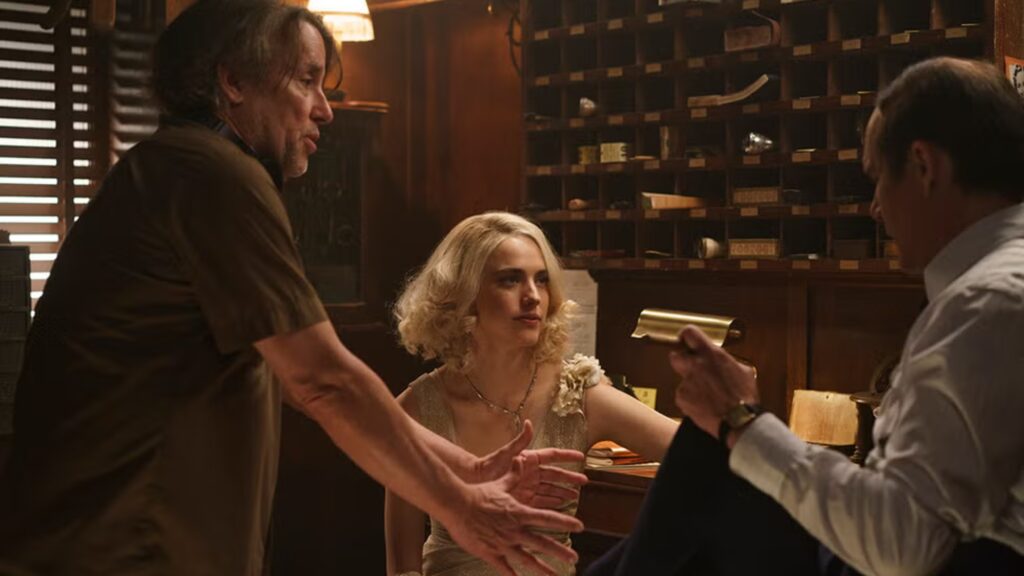
Richard Linklater — a filmmaker known for real time narratives, dialogue intensity, and emotional honesty — brings all these traits to Blue Moon. The film often feels bound to its setting: confined locations, emotionally charged exchanges, and a narrative that moves more through interior shifts than external action.
Cinematographer Shane F. Kelly and editor Sandra Adair use period production design and camera movement to keep the story visually engaging, even within tight spaces, preventing it from feeling static.
Because the movie largely takes place in one evening and one primary locale, it resembles a play captured on film — something critics have both praised for its intimacy and critiqued as stagebound.
Performances That Define the Film.
Ethan Hawke as Lorenz Hart
Hawke delivers what many critics are calling one of his most powerful performances, using physical transformation and emotional subtlety to embody a bittersweet, witty, and deeply vulnerable character. His portrayal captures Hart’s intellectual brilliance while laying bare his self-destructive instincts.
Andrew Scott as Richard Rodgers
Scott’s performance earned festival honors. As Rodgers, he embodies success, confidence, and creative ascendancy — a counterpoint to Hart’s unraveling.
Margaret Qualley as Elizabeth Weiland
Qualley brings warmth, curiosity, and a youthful foil to Hart’s melancholy. Her presence helps open emotional doorways in an otherwise introspective narrative.
Bobby Cannavale as Eddie
Cannavale’s bartender figure provides both comic relief and empathetic grounding, a steady presence amid Hart’s emotional turbulence.
Critical Reception.
Blue Moon has drawn mostly positive reviews: it holds a 91% Tomatometer on Rotten Tomatoes, with critics highlighting its performances — especially Hawke’s — and its poignant reflection on creative decay.
On Metacritic, reviews lean favorable, reflecting appreciation for its craft while noting its deliberate pacing and stage-like structure.
Some critics argue that the film is less about narrative movement and more a meditative evening with a brilliantly flawed creative mind, something that may divide viewers who want traditional storytelling versus those who enjoy character immersion.
Why Blue Moon Matters.
It’s a Rare, Intimate Biopic — Instead of sweeping life histories, Blue Moon zeroes in on a decisive emotional moment.
Performance-Driven — Hawke’s physique, voice, and emotional range make this a performance that could define both his and Linklater’s careers.
Explores Creative Identity — The film asks: what happens when the world moves on but you haven’t? That’s a universal question, and it gives the movie depth beyond its period setting.
Dialogue as Narrative — Its confidence in conversation over action situates it alongside great theatrical cinema.
Awards Presence — With Golden Globe and Academy Award nominations, it has earned cultural recognition beyond its modest box office.
Final Take.
Blue Moon isn’t for everyone — it rewards thoughtfulness, patience, and emotional engagement more than adrenaline or glitter. But for those who appreciate meticulously crafted, personality-driven films, it stands as a luminous meditation on artistry, heartbreak, identity, and the cost of brilliant creativity. Richard Linklater’s direction, Ethan Hawke’s transformative performance, and the emotional immediacy of a night that changes everything make Blue Moon a standout in 2025’s cinematic landscape.
If you like reflective dramas with strong performances and historical depth — films that feel like conversations rather than constructions — Blue Moon is a must-see.