


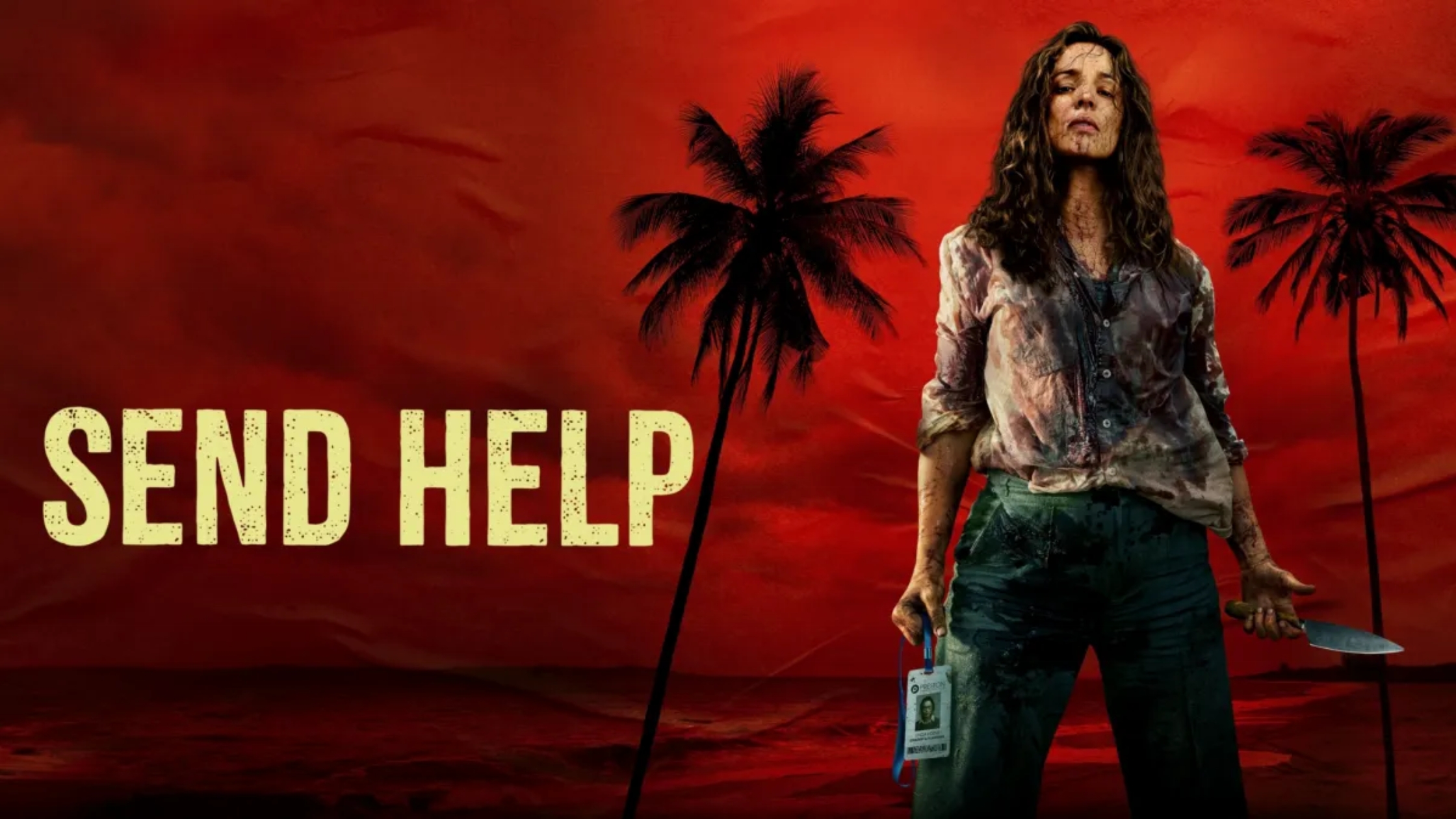
Send Help (2026) — Sam Raimi’s Wild Survival Thriller With Humor, Gore & Power Struggles.
Send Help is a 2026 American survival horror thriller directed and co-produced by genre legend Sam Raimi (Evil Dead, Spider-Man) that blends ferocious tension, dark humor, character drama and visceral horror elements into a story about corporate animosity turned life-or-death survival.
Released in theaters on January 30, 2026 by 20th Century Studios, the Send Help film became both a critics’ favorite — earning strong review scores — and a commercially successful mid-budget release, showcasing how Raimi continues to innovate within horror and genre mash-ups.
How Many Cast — The Main Ensemble.
Send Help uses a compact but effective ensemble of performers, anchoring its tense survival tale with vivid character work. Most of the narrative weight is carried by the key cast members below, though a few smaller parts add color to the story:
Primary Cast (About 7–10 Performers).
- Rachel McAdams as Linda Liddle — a dowdy but resourceful corporate strategist.
- Dylan O’Brien as Bradley Preston — the newly appointed, smug CEO of the company.
- Edyll Ismail as Zuri — Bradley’s fiancée.
- Xavier Samuel as Donovan Murphy — an offhand corporate colleague.
- Chris Pang as Chase — one of Bradley’s inner circle.
- Dennis Haysbert as Franklin — a senior company executive.
- Thaneth Warakulnukroh as boat captain — a minor but important supporting role.
- Emma Raimi as River — Linda’s coworker.
- Kristy Best as Polly Perera — a reporter who later interviews Linda.
There are also photographic cameos (e.g., Bruce Campbell as Bradley’s father), giving the film playful nods to Raimi’s cinematic universe.
Overall, Send Help has around 8–10 credited characters who matter to the plot in one way or another.
Who Is the “Means” (Main) Character?
Though the film is structured as a two-person survival story, the clear central figure — the means character who drives emotional and narrative tension — is Linda Liddle, played by Rachel McAdams.
Linda Liddle — The Heart of the Story
Linda starts as a mild-mannered corporate strategist whose hard work goes unrecognized — especially when her boss’s son, Bradley, passes her over for a promised promotion. Rather than quietly accepting it, her survival instincts (honed from childhood obsession with Survivor) make her unexpectedly lethal and prepared once disaster strikes.
Stranded with Bradley on a deserted island after a plane crash, Linda’s survival skillset gives her power and control in an environment where Bradley’s arrogance and entitlement offer no practical advantage. The evolution of her character — from undervalued office worker to formidable survivor — represents the emotional and narrative core of the film.
Bradley Preston — A Foil Turned Companion
Bradley (Dylan O’Brien) is the deuteragonist and narrative foil — a self-important CEO lacking survival instincts. His dynamic with Linda begins antagonistically and slowly evolves as they confront danger, forcing them to confront deeper personal flaws.
Although the Send Help film focuses on both, Linda’s arc and perspective drive the majority of the thematic development, making her the main character audiences root for and analyze.
Box Office — The Film’s Commercial Performance.
Send Help proved that smart genre films can still succeed in theaters even without blockbuster budgets:
- Production Budget: ~$40 million.
- Worldwide Gross: ~$88.7 million globally.
- Domestic (U.S. & Canada): ~$57.8 million.
- International: ~$28.7 million+.
The film topped the box office on its opening weekend, debuting to about $19.1 million in North America and maintaining audience interest through subsequent weekends.
These figures are especially noteworthy for a genre mash-up that mixes horror, survival and comedy, proving that well-executed original stories can still thrive against franchise competition.

The Niche — Who This Movie Is For.
Send Help sits at the intersection of several audience niches:
Survival Horror Enthusiasts
The core of the film — stranded, survival warfare, and escalating danger — appeals strongly to fans of survival horror and wilderness exploits.
Dark Comedy Lovers
Thanks to Raimi’s signature style and surprising injection of black humor, the movie is not pure horror, but horror-comedy: sharply commented social satire wrapped in bloody survival chaos.
Sam Raimi’s Fans
Longtime followers of Raimi’s work (from Evil Dead to Spider-Man) will appreciate his genre-bending energy, over-the-top visuals and tonal shifts that keep audiences off balance.
Performance Fans
Rachel McAdams and Dylan O’Brien deliver performances that balance comedy, horror and emotional tension, making the film appealing to viewers who want more than jump scares.
Social Commentary Seekers
Beyond gore and laughs, Send Help has been interpreted as a playful commentary on workplace power structures, resilience and underestimated potential, making it resonate beyond pure thrills.
In short, the movie fills a genre-blending niche that appeals to horror die-hards, comedy lovers, and audiences drawn to sharp character work and social satire.

Deep Dive — Story, Themes, Style, and Production.
Plot Summary (No Major Spoilers)
The film opens in the corporate world, where Linda Liddle (Rachel McAdams) is a strategic planner who dreams of a long-awaited promotion. When her former boss’s son Bradley Preston (Dylan O’Brien) takes over as CEO, he gives the promotion to a friend instead — igniting simmering resentment.
Bradley, impressed by Linda’s tough response, invites her on a business trip to Bangkok with a small executive team, including Donovan, Chase and others. But the plane runs into a violent storm and crashes on a remote island, leaving Linda and Bradley as the only survivors.
Stranded and injured, Bradley’s entitlement and arrogance give way to desperation, while Linda’s well-documented survival knowledge (she once auditioned for a reality show like Survivor!) suddenly becomes invaluable. Over time, the power dynamic shifts dramatically: Linda goes from being mocked at the office to controlling the survival situation — building shelter, securing food, and even manipulating Bradley psychologically.
As they struggle to stay alive, the external threat — the wilderness, wildlife and their own injuries — becomes a backdrop for the internal conflict between them: resentment, ego, vulnerability and mutual dependency. Their journey becomes as much about self-discovery and rebalancing power as it is about escape.
Key Themes and Symbolism
The film works on multiple levels, combining survival spectacle with thematic undercurrents:
Power and Resilience
At its heart, Send Help explores how power dynamics shift when traditional hierarchies are destroyed. Linda’s rise from undervalued employee to island authority challenges assumptions about strength and worth.
Workplace Animus as Survival Fuel
The corporate antagonism between colleagues drives the emotional tension, turning office frustration into survival motivation. Bradley’s arrogance is slowly stripped away as Linda reveals her true capabilities.
Dark Humor in Survival Horror
Sam Raimi leans into tonal whiplash — comic scenes (like misadventures hunting food) sit alongside brutal, bloody reality. This mix of humor and horror keeps the audience engaged and unsettled in equal measure.
Redemption and Transformation
Both characters undergo transformations: Linda confronts how she’s been overlooked, and Bradley faces the fragility beneath corporate bravado. The island becomes both prison and proving ground.
Direction, Visual Style and Tone
Sam Raimi’s direction leans into his signature kinetic camera work, genre playfulness and bold visuals. There’s an energy that feels like a fusion of survival thriller, satirical comedy and grotesque horror — much like Raimi’s best known films, but grounded in character work rather than purely supernatural beats.
The score by Danny Elfman heightens both tension and absurdity, using dramatic cues to emphasize emotional beats and horror set-pieces. Meanwhile, cinematographer Bill Pope juxtaposes lush tropical landscapes with close-up visceral chaos, creating a world that is beautiful and terrifying simultaneously.
Setting plays an essential role: the island’s wild unpredictability becomes a character itself — sometimes serene, sometimes lethal — emphasizing isolation, vulnerability and primal survival.
Reception and Audience Response
Critically, Send Help has been very well received: many reviewers praise its blend of dark humor and survival thrills, its strong performances, and Raimi’s command of genre balance. Reviews note that it matches Raimi’s highest ratings since Spider-Man 2.
Audience response, as reflected in verified viewer scores, is likewise strong — with high approval ratings on review aggregators.
Some critics and viewers note pacing issues in the third act or feel the horror elements occasionally undermine its social commentary, but most agree that the film delivers a uniquely entertaining, chaotic, and emotionally engaging experience.
Final Thoughts.
Send Help is a genre-defying survival thriller that combines horror, comedy, character drama, and social satire into a fierce, unpredictable cinematic ride. Anchored by Rachel McAdams’ powerhouse performance and Dylan O’Brien’s dynamic turn, the film makes excellent use of Sam Raimi’s stylistic energy and creative range.
With solid box-office numbers, strong critical reception, and memorable characters, Send Help has proven that original, imaginative films can still succeed in theaters — and it’s a standout entry in early 2026’s movie slate.
Whether you’re a fan of horror, dark comedy, survival dramas, or character-driven storytelling, Send Help offers a wild, gnarly, hilarious, and thought-provoking journey that stays with you long after the crash.